teaching myself about: power substations
date: May 9 2026
Was walking around dumbo park the other day and saw this industrial substation in the middle of this nice neighborhood - which is kinda strange and surprising given the expensive nyc real estate. Decided to snap a couple pictures and deep dive into what this all is and how it works once I got home.
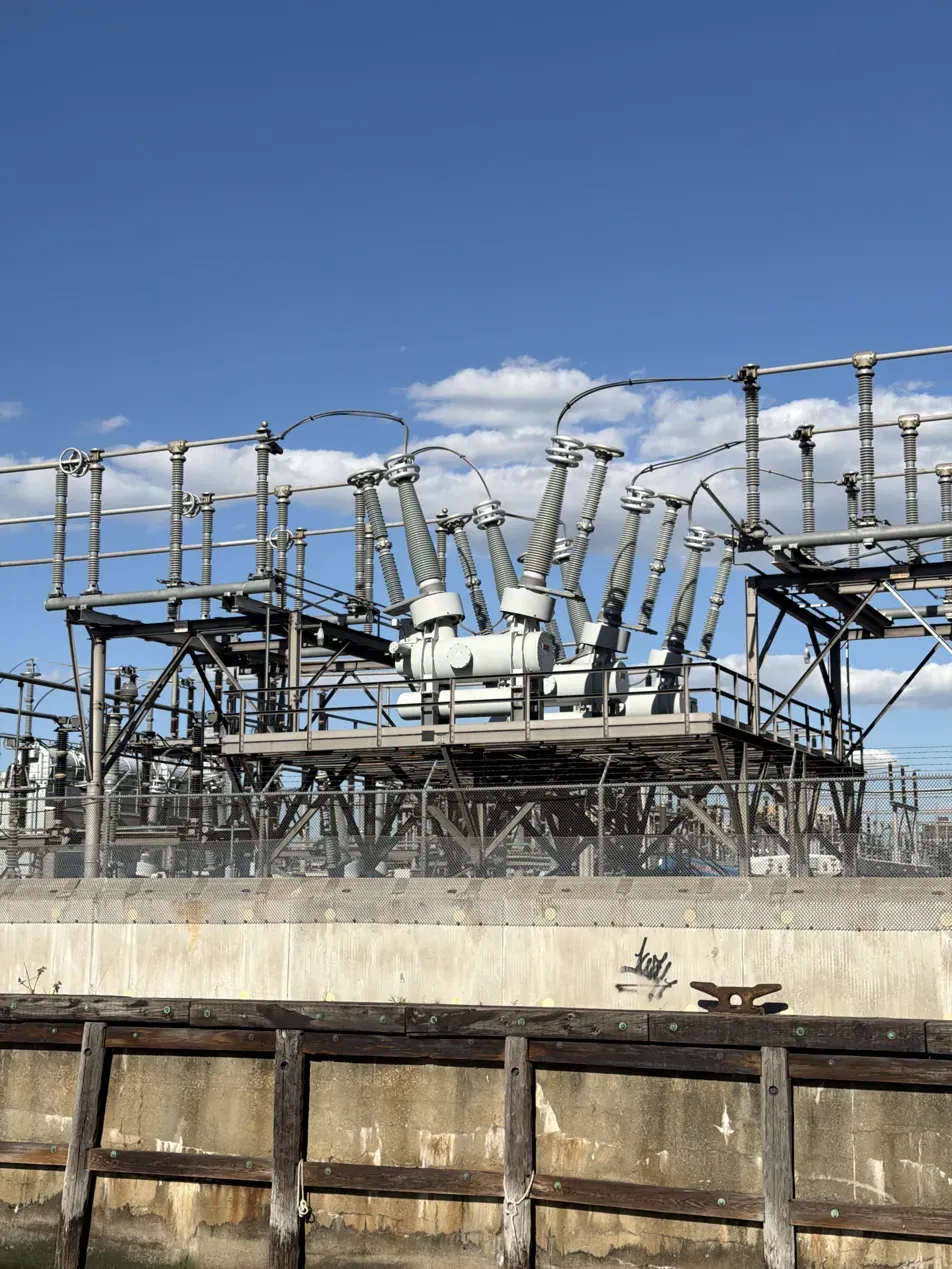
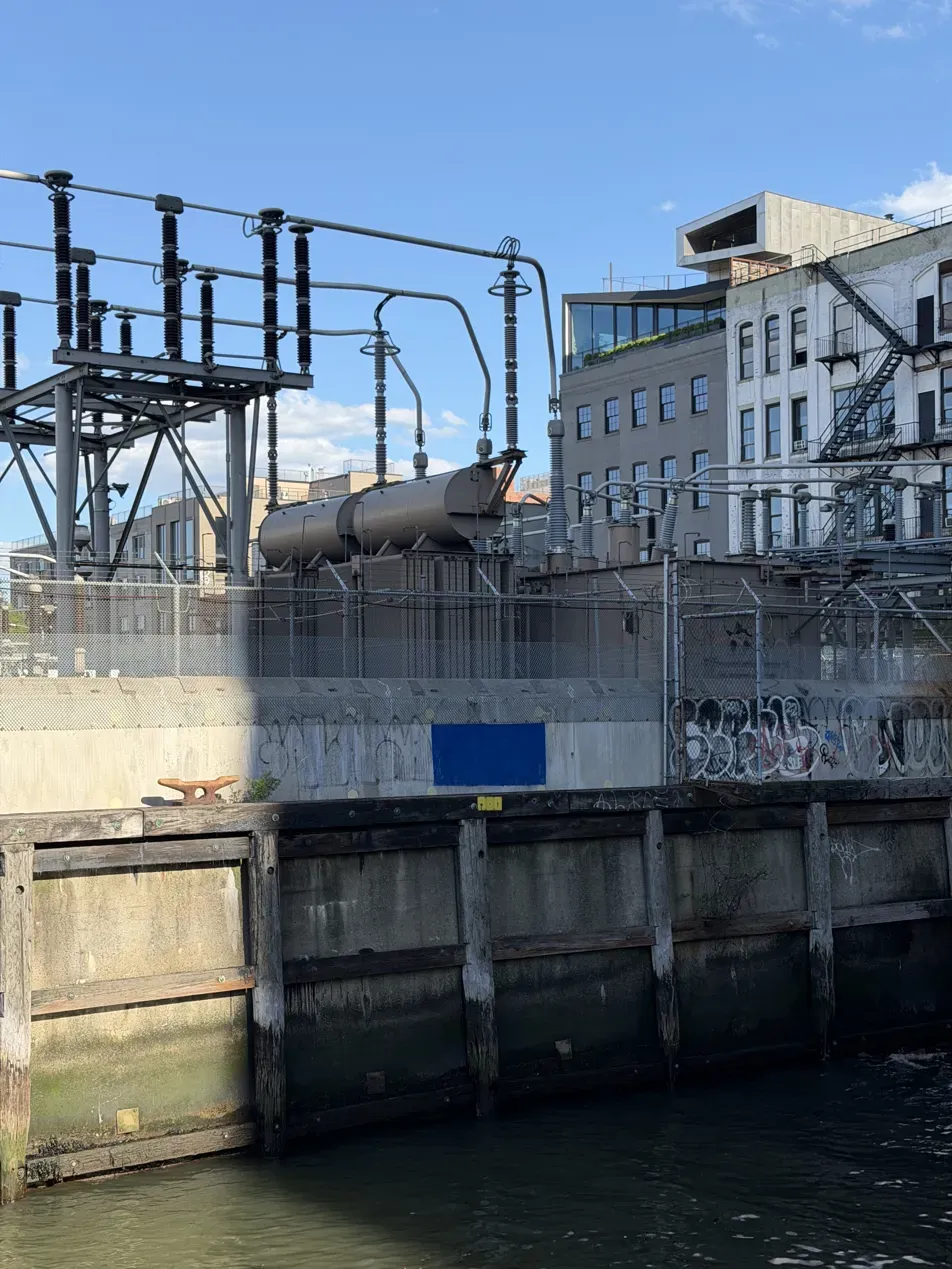
chatgpt and gemini did most of the explaining, the pencil sketches gpt produced for me were especially neat. A few questions got niche enough that I had to either google myself or feed gpt 100-page government PDFs to pin down equipment models and what they actually do, but I think the info I got is mostly accurate.
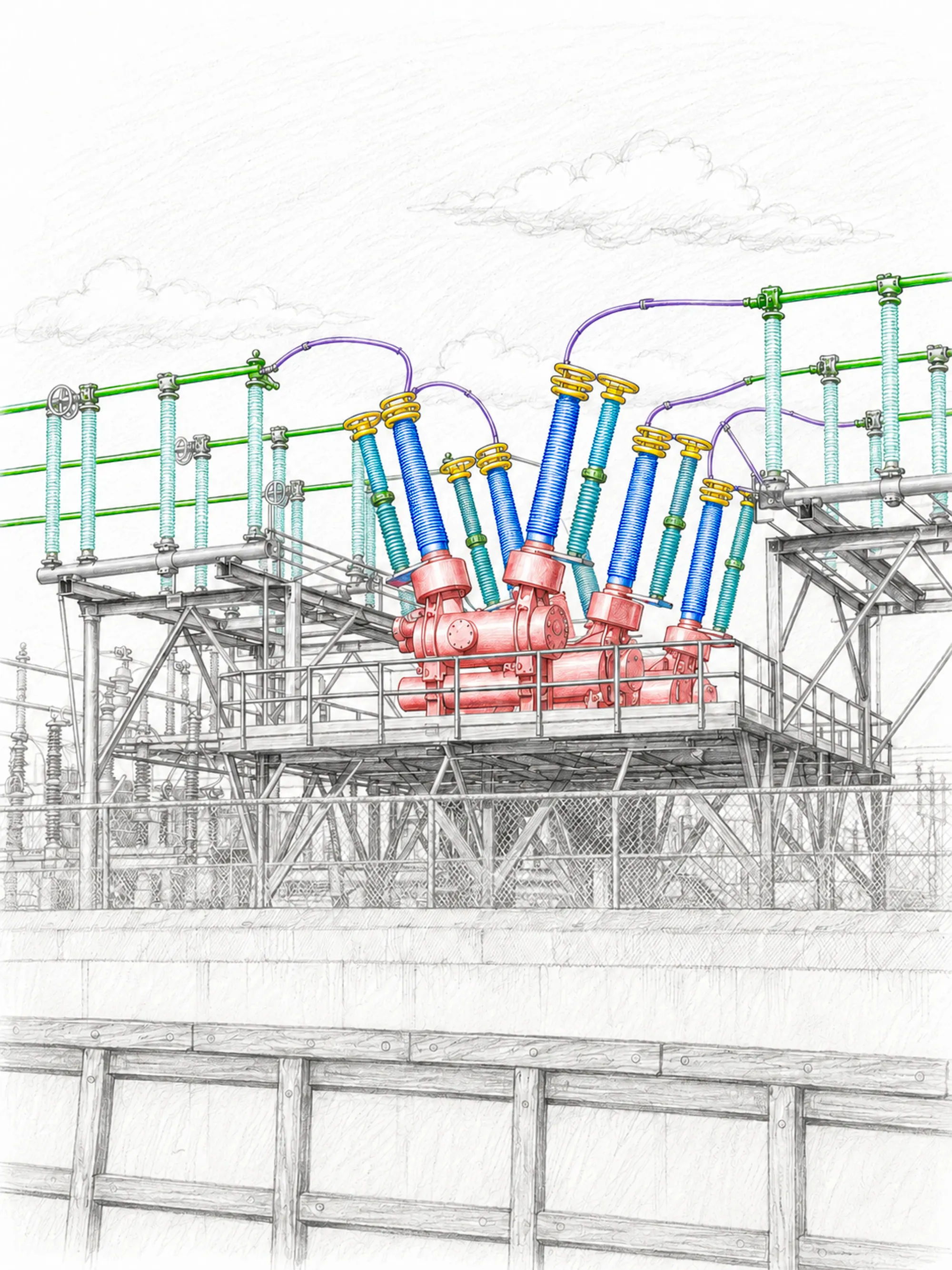
First you will notice essentially one system duplicated 3 times - this is a three-phase AC circuit. Each phase gets its own conductor path and its own breaker pole. together they form a single power line.
- Red - dead-tank high-voltage circuit breaker tanks - these contain the actual interrupter contacts. their job is to interrupt current during faults or switching operations. These appear to be dead-tank SF6 circuit breakers - the grounded metal tank is filled with SF6 gas for insulation and arc extinction.
- Blue - main breaker bushings - The thick ribbed columns on the breaker tank. Their function is to let an energized conductor pass through the grounded metal tank without shorting to the tank body. The ribbed outer structure is external insulation.
- Teal - thinner ribbed side cylinder - This thinner ribbed cylinder installed near/parallel to the main bushing is most likely a grading capacitor, or might be a pre-insertion resistor.
- Purple - flexible jumpers - Flexible conductors connecting rigid busbars to breaker bushings. They carry the actual high-voltage current while allowing movement from wind, thermal expansion, vibration, etc.
- Yellow donut rings - corona / grading rings - These rings smooth out the electric field near high-voltage terminals, clamps, bolts, and sharp edges. At high voltage, sharp metal features can ionize the surrounding air and cause corona discharge.
- Green tubes - rigid busbars - The main high-voltage conductors running across the switchyard. These look like hollow aluminum tubes.
- Mint - high-voltage insulators - The gray ribbed vertical columns. They physically support energized metal conductors in the air while preventing electricity from flowing into the steel frame or ground.
I had more questions, so I kept interrogating ai and google.
further questions
my question - info I found
Red - dead-tank high-voltage circuit breaker tanks
- Why “dead tank”? - “Dead” means the outer tank is grounded. The energized parts are inside and enter through bushings.
- What’s inside the tank? - Fixed contacts, moving contacts, arcing contacts, insulating supports, SF6 gas (sometimes?), and mechanical linkages. Current flows through the contacts when the breaker is closed.
- How does it interrupt current? - Contacts separate, an arc forms, SF6 gas cools and de-ionizes the arc until it extinguishes near an AC current-zero crossing.
- Is it single-use? - No. Can operate many times, but heavy fault interruptions wear the contacts and need inspection/maintenance eventually.
- How fast does it trip? - Typically a few electrical cycles, roughly 50-100 ms total clearing time depending on relays and breaker design.
Blue - main breaker bushings
- Are these just solid? - No. A bushing has a central metal conductor inside, surrounded by insulation and an outer porcelain/composite shell.
- Why ribbed? - Ribs increase creepage distance - the surface path electricity would have to crawl along in rain, fog, dirt, or salt.
- Why angled? - Helps with clearance, phase spacing, and connecting to overhead jumpers without making the breaker footprint too large.
- Why does the diameter change from top to bottom? - Base is thicker because it handles mechanical load, sealing, grounding transition, and high electric-field stress. Top can be narrower since it mainly supports the terminal connection.
Teal - thinner ribbed side cylinder
- Most likely: grading capacitor - Carries only a tiny capacitive current and helps control voltage distribution. If there are multiple interrupter gaps inside the breaker, the open breaker has to withstand a huge voltage across its contacts. Without grading, one gap can accidentally take more of the voltage than the others. The grading capacitor gives the voltage a controlled path to divide itself more evenly.
- Possible alternative: pre-insertion resistor - A PIR briefly inserts resistance during closing to soften voltage surges. It closes first, current flows briefly through the resistor, then main contacts close and bypass it.
Purple - flexible jumpers
- Why not just rigid pipe all the way? - Fully rigid connection would transmit stress into the bushings, could crack or loosen equipment. The jumper gives mechanical slack.
Yellow donut rings - corona / grading rings
- What is corona discharge? - Partial ionization of air around high-voltage conductors. Causes energy loss, radio interference, buzzing/hissing, ozone, and surface damage over time.
- Why do rings prevent it? - They make the terminal look electrically larger and smoother. Spreads the electric field instead of concentrating it at sharp edges.
- Are the rings coils? - No. Not transformer coils or inductors - just field-shaping metal rings.
- Why placed near the jumper connection? - That’s where you get clamps, bolts, bends, and edges - all places where electric fields concentrate. The ring reduces that local stress.
Green tubes - rigid busbars
- Why tubes instead of wires? - Tubes are stiff, stable, and maintain fixed clearances. Wires would sag, swing, and be harder to support precisely.
- Are they insulated? - Usually no. Bare energized metal - insulation is provided by air gaps and physical distance.
- Hollow or solid? - Usually hollow. Lighter, mechanically strong, and AC current mostly flows near the surface anyway.
- Why aluminum? - Conductive, lightweight, corrosion-resistant, and cheaper than copper for large outdoor buswork.
- Why not cover them in rubber? - At these voltages, ordinary insulation would be huge, expensive, weather-exposed, and hard to maintain. Outdoor substations mostly just use air as insulation.
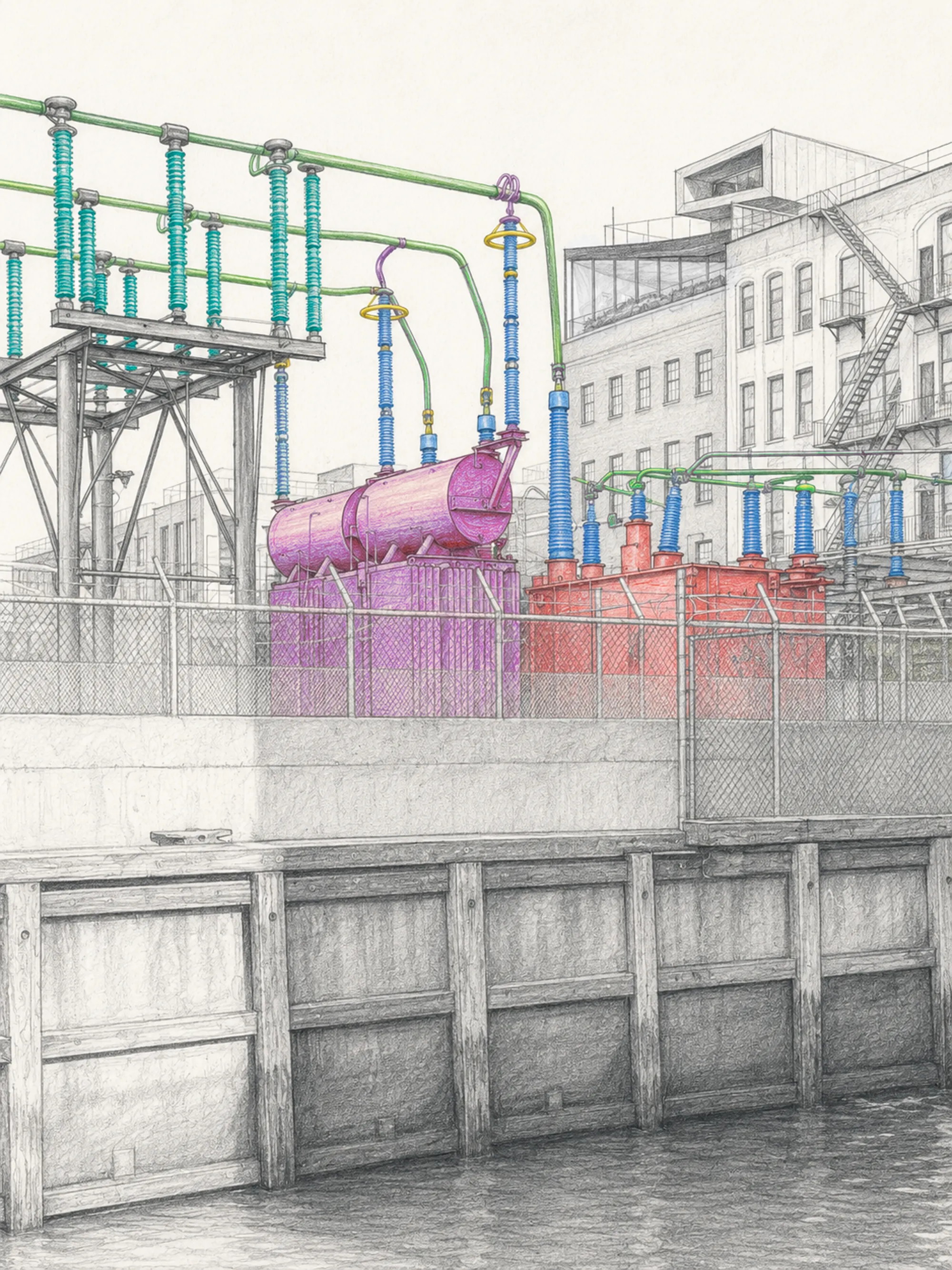
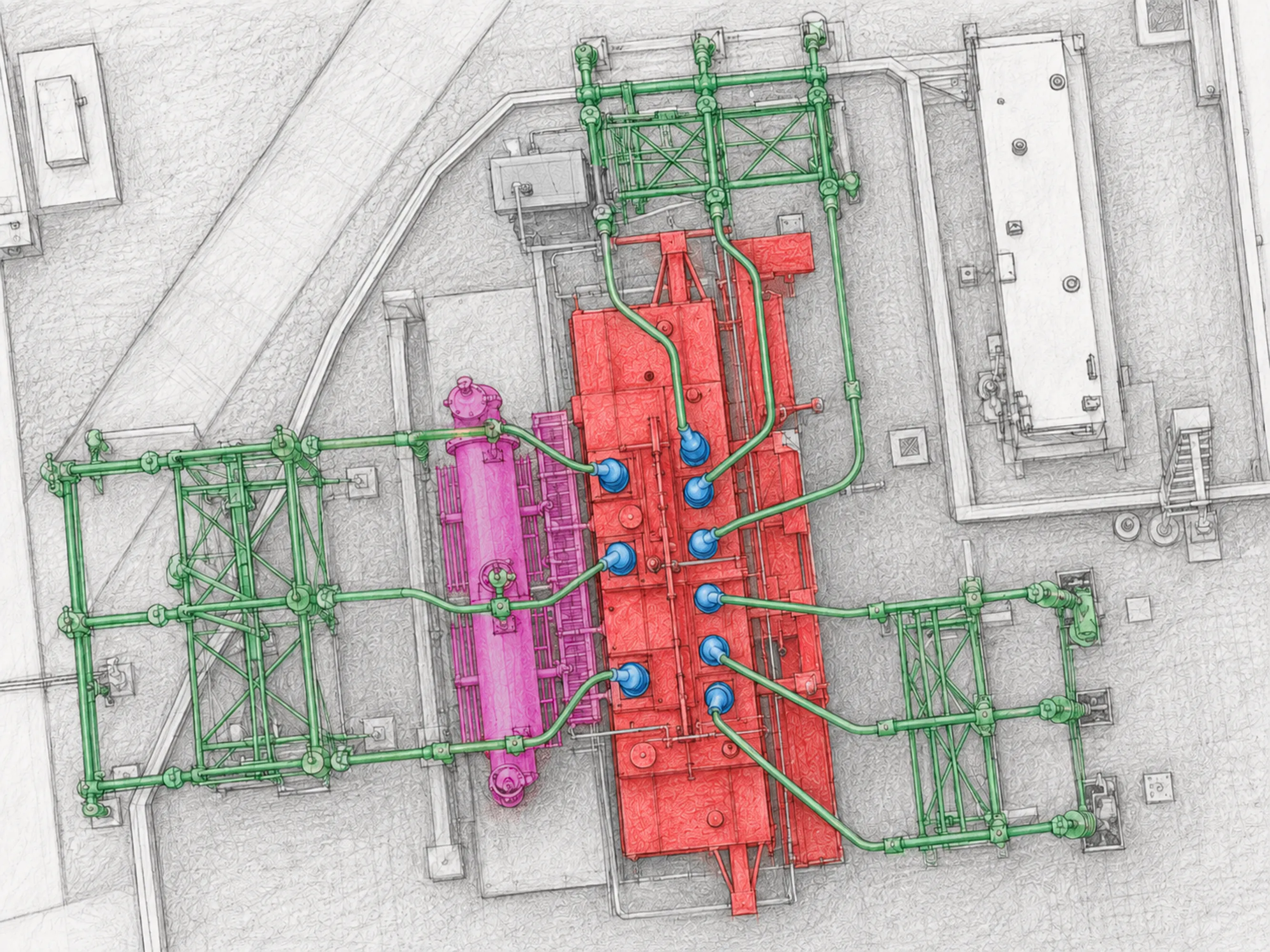
Now going towards the box to the right of circuit breakers.
Here we see similar structures with busbars, insulators and bushings going into a red box. It has 3 connections on one side, and 6 on another. This looks like a Phase Angle Regulator assembly. The red box - PAR - can change the phase angle between the input and output side of a high-voltage line, which lets grid operators control how much real power flows over that path.
A PAR works by introducing a controllable voltage that is in quadrature (90deg out of phase) with the phase-to-neutral voltage. By injecting this out of phase voltage, it shifts the overall phase angle between the sending and receiving ends of the line. Because active power flow is largely dependent on the relative voltage angle between two buses, shifting this angle directly controls the amount of power passing through.
Highlighted in purple are the oil radiators. They cool the insulating oil as it heats up inside the PAR. The horizontal cylinder on top is likely an oil conservator or expansion tank. Transformer oil expands and contracts as temperature changes, so the conservator gives the oil extra volume to move into instead of over-pressurizing the main tank. It also helps keep the main tank properly filled.
the substation map
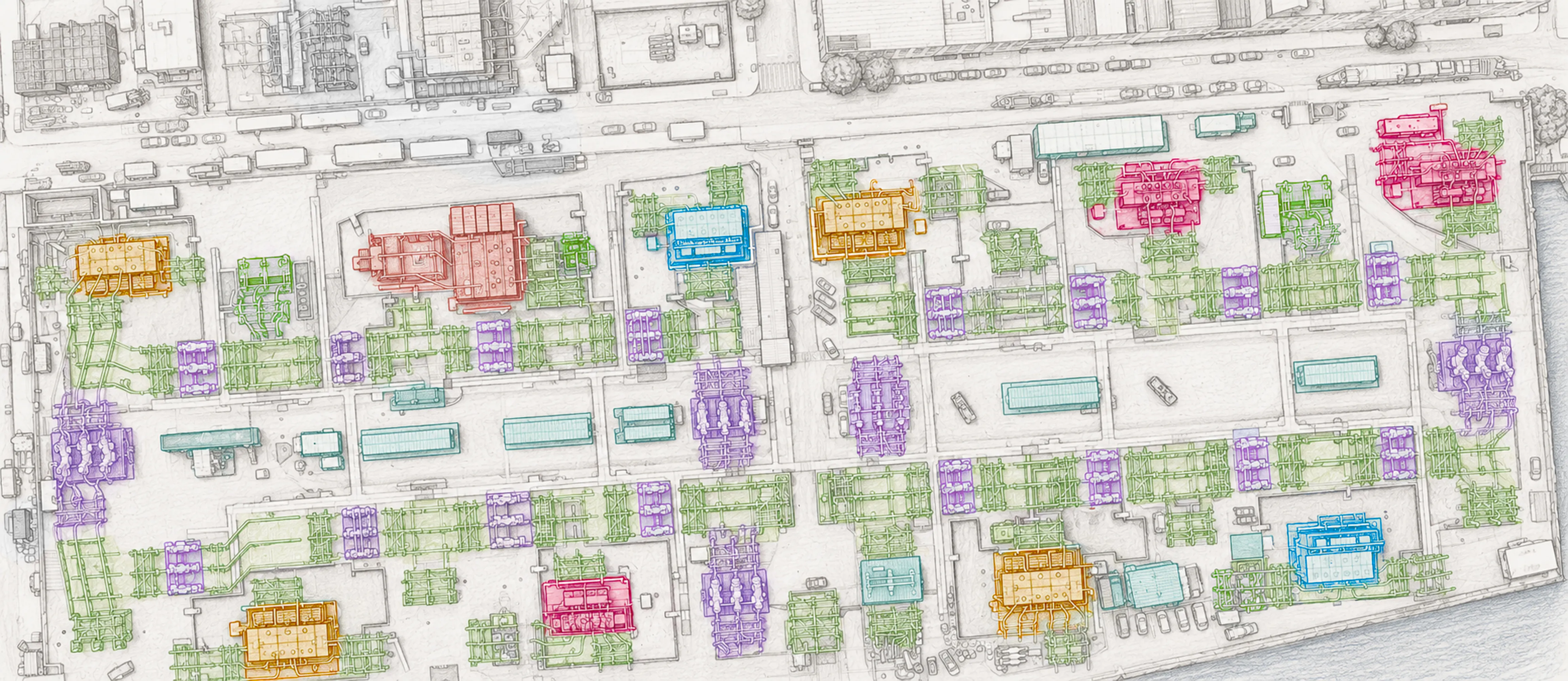
label: GREEN - air-insulated busbars, disconnects, post insulators, and steel support frames. PURPLE - dead-tank circuit breakers, repeated many times because each major feeder, PAR unit, reactor, or bus section needs its own protection and isolation. RED/ORANGE/PINK/BLUE - box units are large oil-filled PAR transformers, grouped by device model.
This place is Con Edison’s Farragut Substation in Brooklyn, a major 345 kV transmission switching and control node. Its job is to route, protect, and control high-voltage power moving between New York City load centers, New Jersey interties, nearby Con Edison substations, and newer clean energy interconnection infrastructure. It matters because it is part of the bulk-power backbone upstream of neighborhood distribution.
Con Edison’s NYC grid works in layers:
- Power first moves through the bulk transmission system at 345 kV, 138 kV, and 69 kV.
- Then area substations step it down to primary distribution voltages such as 27 kV in Brooklyn/Queens or 13 kV in Manhattan.
- From there, underground feeders supply local network transformers, which finally step power down to building voltages like 2-phase 120 or 3-phase 208 V.
Farragut also connects into New Jersey through 345 kV interties such as Hudson-Farragut and Marion-Farragut. It connects into Con Edison’s internal NYC 345 kV network through paths such as Farragut-Rainey and Farragut-East 13th Street. It is also next to the Brooklyn Clean Energy Hub, which is meant to add new 345 kV interconnection capacity for future clean-energy sources.
Farragut has 4 main responsibilities as far as I could find:
- switching - connect or disconnect major 345 kV circuits, bus sections, PARs, reactors, transformers, and feeder paths. This lets operators change the grid topology during normal operation, maintenance, outages, or emergencies.
- protection - If a cable, transformer, breaker, bus section, bushing, or PAR has a fault, protection relays detect the abnormal current/voltage condition and trip the correct circuit breakers. The goal is to isolate only the failed section while keeping the rest of the substation and surrounding grid energized.
- power-flow control - The PAR equipment can shift phase angle to control how much real power flows over certain 345 kV paths, especially interties between New York and New Jersey. This helps prevent one path from overloading while another path is underused.
- voltage and reactive-power control - Equipment such as shunt reactors, transformer-family devices, and newer STATCOM-type equipment can absorb or inject reactive power to keep voltage stable. This is especially important in a dense urban grid with long underground or underwater high-voltage cables.
random interesting thing:
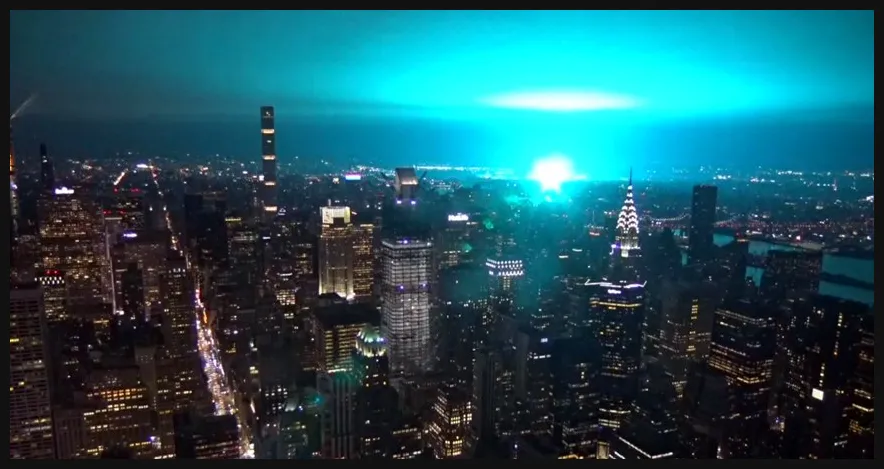
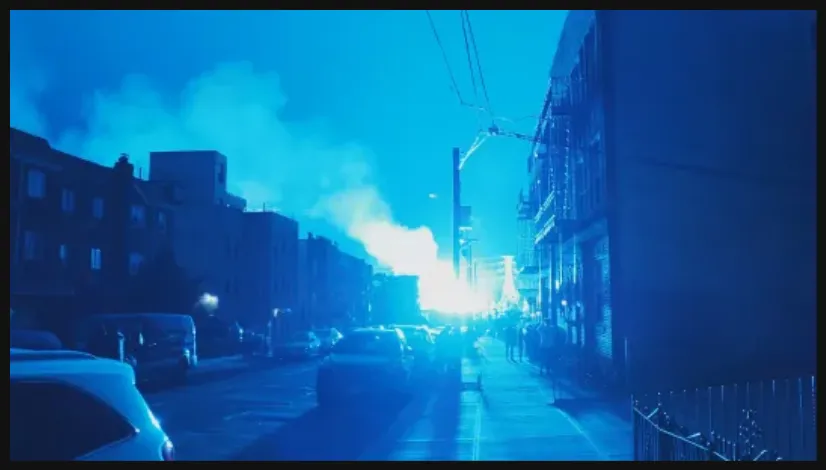
“On December 27, 2018, a severe electrical arc flash occurred at the Con Edison Astoria East Substation in Queens, triggered by the failure of a 138kV coupling capacitor potential device. The failure caused a sustained, bright blue-green light that illuminated the NYC skyline”
further questions that come to mind
- power trading desks - citadel, squarepoint, etc. have teams of people for weather and energy forecasting and trade financial derivatives exposing them to energy markets. lots to learn there.
- national power grid system design - how fault tolerant is it? how does it grow? how is capacity defined? industries and companies involved?
- cybersecurity of power grids - pretty self-explanatory, controlling this gives anyone a lot of power, so there is a lot here to deep dive into.